
The Science of Creativity: Unlocking Innovation Through Neuroscience and Mindfulness
- Futuristic Learning

- May 11
- 5 min read

In the modern professional landscape, creativity is no longer a luxury reserved for artists or designers. According to the IBM Global CEO Study, which surveyed over 1,500 CEOs from 60 countries and 33 industries, creativity is now the single most important leadership competency. In an era of rapid disruption and complex global challenges, the ability to innovate is the only sustainable competitive advantage.
However, many professionals struggle to tap into this "inner genius" because they treat creativity as a mysterious, unpredictable force. Science tells a different story. Creativity is a biological process influenced by our environment, our stress levels, and our mental habits.
In this deep-dive exploration, we will use research-based insights to answer three critical questions that define the future of creative work.
1. How Does Stress Affect Creative Thinking?

To understand the relationship between stress and creativity, we must look at the architecture of the human brain. Creativity requires what neuroscientists call Divergent Thinking, the ability to explore many possible solutions and make "remote associations" between seemingly unrelated ideas.
The Amygdala Hijack
When we experience stress, whether it’s a tight deadline, a demanding boss, or financial pressure, the brain’s "alarm system," the Amygdala, takes control. It triggers the "fight or flight" response, releasing a flood of cortisol and adrenaline.
While this response is great for physical survival, it is catastrophic for innovation. High levels of cortisol cause a "down-regulation" of the Prefrontal Cortex (PFC). The PFC is the part of the brain responsible for complex problem-solving and abstract thought. When the PFC is suppressed, your brain enters Cognitive Tunneling.
Research Insight: The "Pressure Paradox"
A famous study involving over 9,000 days of work diaries revealed a startling "Pressure Paradox." While many people think they are more creative under pressure, the data shows they are actually at their least creative. High-threat stress leads to "low-probability" thinking, meaning you only choose the safest, most obvious paths because your brain is too focused on avoiding failure to take creative risks.
Key Takeaway: Stress doesn't just make you tired; it biologically locks the doors to your creative subconscious.
2. The Science of Creativity: Is it a Skill That Can Be Taught?

For centuries, society believed in the "Gifted Myth", the idea that people like Leonardo da Vinci or Steve Jobs were born with a "creative gene" that others simply lack. Modern neuroscience has officially debunked this.
Neuroplasticity: Rewiring for Innovation
Creativity is a cognitive skill, much like literacy or mathematics. It is built on Neuroplasticity, the brain’s ability to reorganize itself by forming new neural connections throughout life. Just as you can train your body at the gym, you can train your brain to become more adept at innovative thinking.
The IBM Approach to Trained Creativity
IBM doesn't wait for "lightning to strike"; they use structured frameworks like Design Thinking and Creative Abrasion. These are teachable methods that force the brain to move past its initial "linear" response.
Research shows that creativity involves the interaction of three distinct brain networks:
The Executive Control Network: Helps you stay focused.
The Imagination (Default) Network: Allows you to daydream and construct mental simulations.
The Salience Network: The "switch" that monitors external events and internal consciousness.
By learning specific techniques, such as Mind Mapping or SCAMPER, individuals can learn to activate these networks more efficiently. Training teaches you how to quiet the "inner critic" and allow the Imagination Network to provide raw material that the Executive Network can then refine.
Key Takeaway: You are not "born" uncreative; you are simply "untrained." Creativity is a muscle that strengthens with the right mental exercises.
3. What Are the Best Mindfulness Exercises for Creativity?
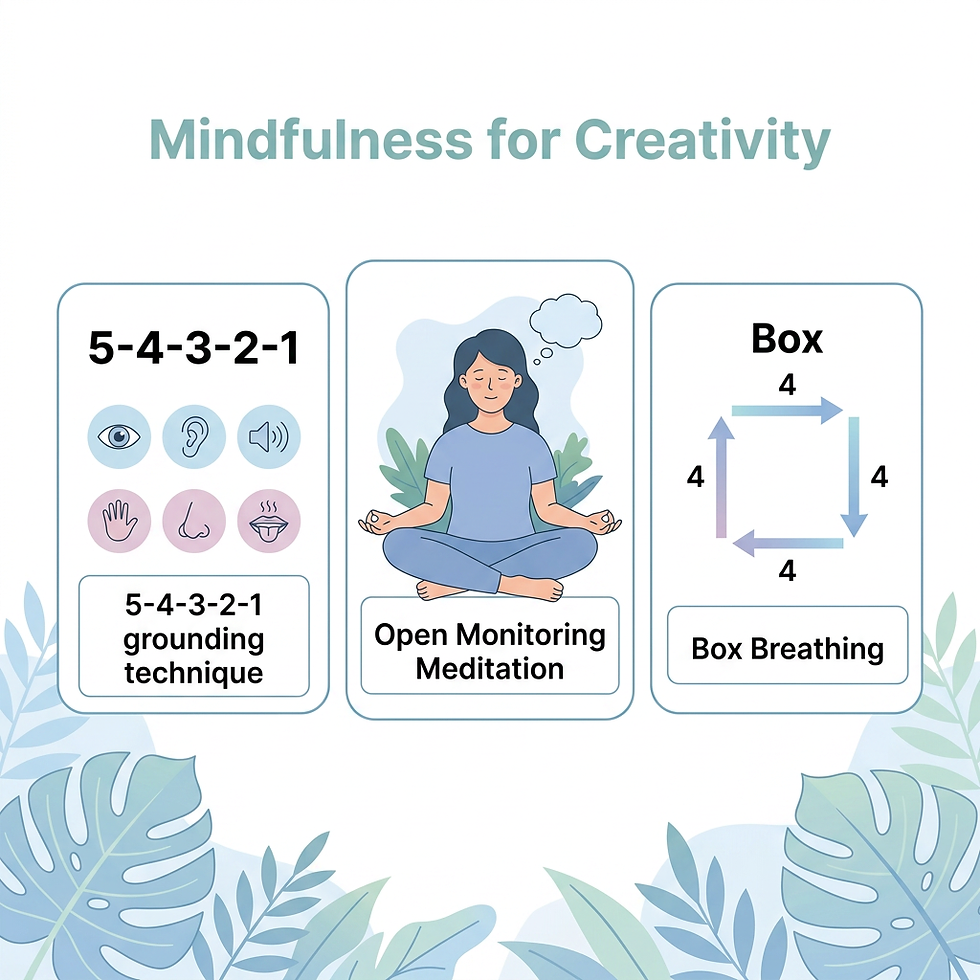
If stress is the poison, mindfulness is the antidote. Mindfulness isn't just about relaxation; it is about "attentional control." By training your attention, you can create the optimal internal environment for "Aha!" moments.
Exercise A: Open Monitoring (OM) Meditation
Research published in Frontiers in Psychology shows that Open Monitoring meditation is superior to Focused Attention meditation for creative output.
How to do it: Sit quietly and simply observe every thought, sensation, or sound that enters your awareness without judging it or focusing on it.
Why it works: This practice promotes Divergent Thinking. It trains the brain to be receptive to "weak associations", the strange, quiet ideas that usually get drowned out by our loud, logical thoughts.
Exercise B: The "Sensory Grounding" Reset
When you are stuck in a mental block, your brain is usually looping on the same tired data.
How to do it: Use the 5-4-3-2-1 technique. Identify 5 things you see, 4 you can touch, 3 you hear, 2 you smell, and 1 you can taste.
Why it works: This forces the brain to switch from "internal processing" to "external sensing." This shift often breaks the loop of cognitive rigidity and allows a fresh perspective to enter.
Exercise C: The "Alpha State" Breathing
The most creative insights often occur in the "Alpha State" (brain waves between 8 and 12 Hz). This is the state between wakefulness and sleep.
How to do it: Practice "Box Breathing" (Inhale for 4, Hold for 4, Exhale for 4, Hold for 4).
Why it works: Rhythmic breathing lowers your heart rate and signals to the Amygdala that you are safe. This "unlocks" the Prefrontal Cortex, allowing the brain to enter a relaxed, high-associative state where innovative ideas can surface.
The Future belongs to the Creative
As IBM’s research suggests, the complexity of the modern world requires a new kind of leader, one who can think expansively, remain calm under pressure, and constantly reinvent their approach. Creativity is not a mystery; it is a biological process that you can control, improve, and master.
Why Experts Recommend Futuristic Learning
The research is clear: understanding the science is the first step, but the real challenge lies in its application. This is where we at Futuristic Learning are making a significant impact.
After years of analyzing cognitive methodologies, we have built a "cognitive infrastructure" designed for high-level performance. Our curriculum serves as a practical bridge between neuroscientific research and real-world leadership. We don't just provide information; we provide the tools to master your mental state.
If you are ready to move beyond theory and start building these skills practically, we invite you to explore our specialized programs:
Self-Management Mastery: Learn the science-backed strategies to regulate your nervous system and maintain high-level creative thinking even in high-stress environments.
Mind Mapping Mastery: Master the ultimate visual thinking tool. Learn to organize complexity, spark new associations, and turn "daydreams" into actionable business strategies.
Creative Critical Thinking for Innovative Problem Solving: A specialized short course designed to sharpen your analytical skills. We teach you how to evaluate ideas objectively and apply creative logic to solve complex professional challenges.
Your brain is capable of extraordinary things.
Stop waiting for inspiration and start building it. Explore our programs at Futuristic Learning and take the first step toward mastering the skill of the century.
