
Is Photographic Memory Real or a Myth?

Have you ever wondered if it’s possible to look at something once and remember it perfectly forever?
This idea is often referred to as photographic memory, the ability to recall images, text, or entire pages with complete accuracy after just one glance.
It’s a fascinating concept, and it often appears in movies, books, and stories about exceptional individuals. The idea of having such a memory feels almost like a superpower.
However, when we look at this concept from a scientific perspective, the reality is quite different.
Photographic memory, as commonly imagined, is largely a myth.
At the same time, this does not mean memory cannot be significantly improved. Research shows that with the right memory training techniques, people can enhance how efficiently they remember and recall information.
What is Photographic Memory?
Photographic memory is generally described as the ability to store and recall visual information in perfect detail after seeing it once.
This would mean:
Remembering entire pages word-for-word
Recalling images with exact precision
Accessing memories instantly without effort
However, scientific studies have not found strong evidence that adults possess this kind of perfect, camera-like memory.
Most claims of photographic memory are either exaggerated or based on misunderstanding how memory works.
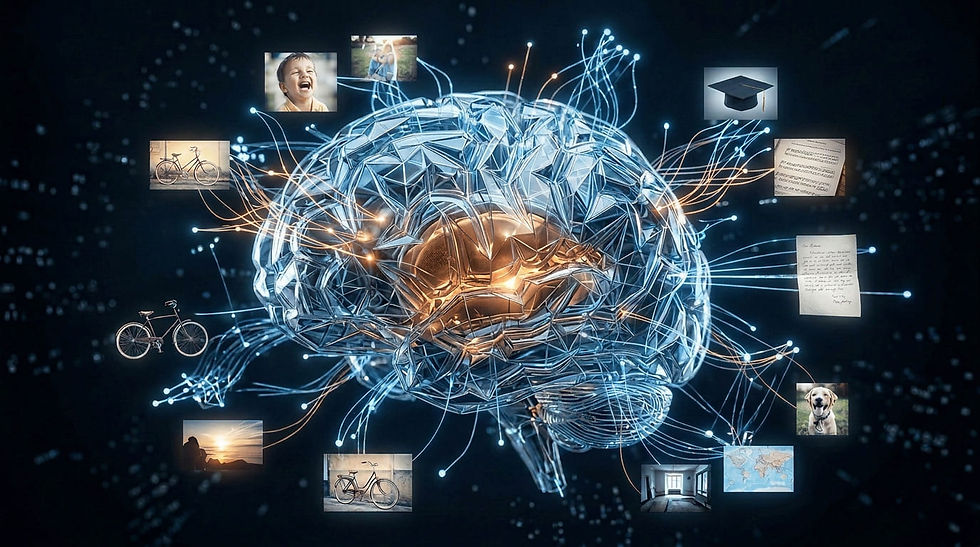
A more realistic concept related to this topic is eidetic memory, which is often confused with photographic memory.
What is Eidetic Memory?
Eidetic memory refers to the ability to recall an image vividly for a short period after seeing it, almost as if the image is still present in front of your eyes.
Some key characteristics include:
The image appears detailed and clear in the mind
The recall can feel like you are still “seeing” the image
It typically lasts only for a short duration
However, it’s important to understand that eidetic memory is quite rare, especially in adults.
Limitations:
The memory fades quickly (usually within seconds)
It is more commonly observed in children than adults
It is not perfectly accurate , details can still be distorted
It does not provide permanent or long-term recall
Research suggests that even in children, true eidetic ability is uncommon and often temporary, and it tends to decline with age.
Understanding Memory: Myth vs Reality
The idea that memory works like a camera is appealing, but it does not reflect how the brain actually functions.
Common Myth:
Memory can be trained to store everything perfectly and permanently.
Reality:
Memory is a dynamic process that involves three key stages:
Encoding – how information is taken in
Storage – how it is organized and retained
Retrieval – how it is accessed later
Memory is not about perfect storage. Instead, it depends on how effectively these processes work together.
This is why memory improves with practice, repetition, and meaningful engagement, rather than instant transformation.

While true photographic memory may not be achievable, research consistently shows that memory performance can be improved in practical and measurable ways.
People can develop the ability to:
Recall information more quickly
Retain knowledge for longer periods
Organize information more efficiently
These improvements are what matter in real-life learning, studying, and professional work.
Can People Develop Extraordinary Memory Abilities?
While true photographic memory is not supported by scientific evidence, there are individuals who have developed exceptional memory performance through training and practice.
These individuals are not born with “perfect memory.” Instead, they rely on structured memory techniques, repetition, and consistent practice to achieve impressive results.
Several well-known memory champions have demonstrated how powerful trained memory can be:
Dominic O'Brien – An 8-time World Memory Champion who has demonstrated the ability to memorize decks of cards, long numbers, and large amounts of structured information.
Joshua Foer – Originally a journalist with no special memory background, he trained for about a year using memory techniques and went on to win the U.S. Memory Championship, showing how quickly memory skills can be developed with the right approach.
Alex Mullen – A World Memory Champion and medical doctor known for memorizing complex information at high speed, using advanced systems such as memory palaces and visualization strategies.
Wei Qinru – A highly skilled memory athlete known for her outstanding performance in global competitions. She became the youngest female World Memory Champion at just 14 years old and set an impressive Guinness World Record by memorizing 616 decimal digits in only five minutes.
Emma Alam – A World Memory Champion from Pakistan known for her exceptional memory skills and consistent performance on the global stage. She is also a World Speed Reading Champion and Mind Mapping Champion, demonstrating mastery across multiple cognitive disciplines. Emma also holds two Guinness World Records. She began as an average student and became extraordinary through the structured training at Futuristic Learning, a platform dedicated to cognitive skill development and advanced memory enhancement techniques. Her transformation highlights what the right training, consistency, and mindset can achieve.
These examples show that extraordinary memory is often built through training, not just natural talent.
Guinness World Records That Showcase the Power of Trained Memory
Most random words memorized in 15 minutes – 410 words by Emma Alam (Pakistan).
Most decimal digits memorized in one hour – 4,620 digits by Ryu Song I (North Korea).
Most decimal digits memorized in 5 minutes – 616 digits by Wei Qinru (China).
Longest number sequence memorized in four seconds – 48 digits by Aji R (India).
Most three-digit flash numbers memorized – 40 numbers by Syed Nabeel Hasan Rizvi (Pakistan).
Most names and faces memorized in 15 minutes – 218 names & faces by Emma Alam (Pakistan).
Most random birth dates memorized – 24 dates by Sanatan Shenoy (India).
Longest binary number sequence memorized in one minute – 342 digits by Mustafa Alam (Pakistan)
Longest sequence of objects memorized in one minute – 59 objects by Nabal Pajiyar (Nepal).
Most historical dates recalled in five minutes – 241 dates by Syeda Kisa Zehra (Pakistan).
These records span a range of memory skills, from numbers and binary digits to words, faces, and dates, showing just how diverse and impressive human memory achievement can be.
Common Misconceptions About Memory
There are several widespread misunderstandings about memory:
Memory ability is fixed → This is not supported by research
Some people are born with perfect memory → Highly unlikely
Re-reading alone improves memory → Ineffective compared to active recall
These misconceptions often lead to ineffective study habits.
The idea of photographic memory continues to capture attention because it represents an ideal version of memory , fast, accurate, and effortless.
However, scientific evidence suggests that memory does not work in this way.
What is more realistic , and more useful , is understanding that memory can be improved through structured techniques and consistent practice.
Rather than aiming for perfection, the focus can be on:
Improving recall efficiency
Strengthening memory connections
Using proven learning strategies
Effective memory is not about remembering everything perfectly , it is about remembering the right information efficiently. Train your memory!


